Product description
This service requires assistance from our company's professional staff. If needed, please contact our customer service.

This service requires assistance from our company's professional staff. If needed, please contact our customer service.
AI-AMCT System Introduction
Subluxation is a key component of current Western AMCT chiropractic therapy. Subluxation refers to a subtle misalignment between adjacent vertebrae, a condition that cannot be diagnosed with modern medical equipment. Besides external force impact, subluxation is most often caused by long-term incorrect posture or occupational stress. Subluxation can occur in six different directions along the body's three axes, including left and right rotation, The human spine contains a central nervous system and controls the sympathetic and parasympathetic nervous systems. Generally speaking, the seven cervical vertebrae control nerves above the shoulder blade and upper limbs, the 12 thoracic vertebrae control nerves for the internal organs, and the five lumbar vertebrae control nerves for the urogenital system and lower limbs.
By identifying the correct direction of a microdislocated vertebra and using a spinal activator (meridian gun) to restore it to its normal position, the symptoms of the nerves controlled by that vertebra will naturally disappear, without medication! Therefore, the two most important aspects of AMCT chiropractic treatment are: first, how to determine which vertebrae are microdislocated based on the patient's symptoms; and second, how to determine the direction of the microdislocation in the suspected vertebrae. If these two issues can be resolved quickly and accurately, subsequent treatment with a spinal activator becomes a standard procedure. (SOP).
Many patients worldwide visit hospitals and, after undergoing various modern medical testing equipment, are reportedly cleared by doctors, yet their symptoms persist. Most doctors simply prescribe painkillers, muscle relaxants, and sleeping pills. However, these treatments only result in recurring symptoms: persistent pain, numbness, and insomnia, completely failing to address the underlying cause. Many people have experienced this. In fact, over 80% of these patients, unless they have a viral infection, have their symptoms caused by spinal subluxation.
The AI-AMCT system collects numerous successful chiropractic case studies, building a massive database and systematically establishing an automated screening mechanism for suspected subluxations corresponding to patient symptoms. As feedback and data on successful chiropractic cases are collected, this automated screening mechanism will be adjusted using intelligent big data learning. This will address the current lack of systematic automation in chiropractic care.
Every living being has thoughts, which contain the various instructions of the human mind. Thoughts can be transmitted between people. This invisible transmission of thoughts is called "induction," which is not limited by time or distance. Contact between people through sight, hearing, touch, smell, and taste is a tangible transmission of thoughts, called "correspondence," which is limited by time and distance. The closer the distance and the longer the time, the stronger the signal of thought transmission and correspondence. Each person's thoughts can be detected by an electroencephalogram (EBOD) monitor, which displays them as electromagnetic waves. Changes in a person's thoughts can also be represented by a series of electromagnetic waves. Therefore, the transmission and interaction of thoughts between people can be analyzed and compared through a series of electromagnetic wave reactions between both parties.
AI-AMCT has proven that "thought detection" can identify consistent correlations by comparing large amounts of EEG data from both parties (patients and doctors). Through extensive EEG test data analysis, it has been found that commands detected through "thought detection" have a high probability of corresponding to certain EEG wave bands of both parties. This relative relationship was developed into an automated "research algorithm" for identification software. Repeated blind testing with physicians resulted in a high agreement rate of over 80%. Subsequently, through repeated revisions to the identification software, a consistent success rate of over 90% was achieved.
- Suitable for:
1. Patients with recurrent neuralgia who persist despite unresponsive Western medical equipment and who are prescribed only painkillers, muscle relaxants, and sleeping pills.
2. Patients with recurrent neuralgia caused by occupational illness, poor posture, or modern health issues (such as phone addiction).
3. Sudden or rapidly treatable conditions, such as stiff neck, poor gastrointestinal motility, and sudden impact or spinal sprains.
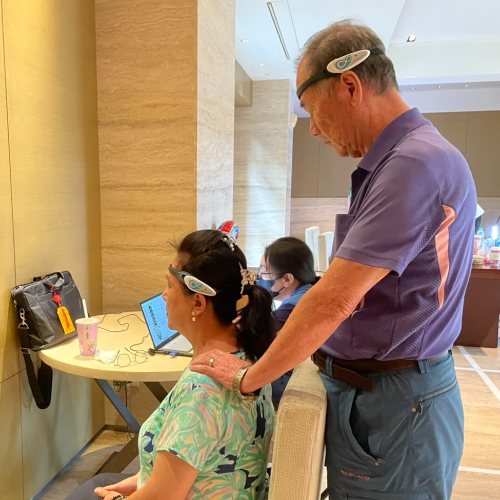
This system utilizes neurofeedback technology and an EEG-based brainwave matching algorithm with analysis capabilities. It comprises two non-invasive EEG detection units (EEGs). The tester's mental commands are matched to the testee's thoughts, and the brainwave data from both parties is input into the system. The calculation module receives signals from two sets of brainwave detection units within a time period of t and processes the data. The processed brainwave outputs contain the respective relaxation (Meditation) and concentration (Attention) indices, as well as indices for various electromagnetic wave frequency bands, including α-, α+, β-, β+, γ-, γ+, δ, and θ. By integrating multiple sets of repeated test data and analyzing and statistically analyzing them using a specific Big Data artificial intelligence (AI) algorithm, the calculation system module outputs a test success/failure determination (Go or No Go). A "No Go" indicates a repeat test, while a "Go" indicates a characteristic comparison of the test subject's brainwave responses to the tester's intended brainwave commands. The calculation system module then outputs a "Pass" or "Fault" result.
Basically, AI-AMCT is currently limited to analyzing and testing the 24 vertebrae (seven cervical vertebrae, twelve thoracic vertebrae, and five lumbar vertebrae) for micro-dislocations. For other serious spinal deformities that can be identified with modern medical equipment or seen with the naked eye, there is no need for AI-AMCT testing.
- Operational Precautions
A. Prohibitions:
1. Users of the Vibration Gun therapy must possess a valid license in the country of use.
2. Pregnant women (prohibited, extremely dangerous)
3. Those who have undergone spinal surgery (prohibited, absolutely avoided)
4. Extremely elderly individuals and those with severe osteoporosis (prohibited, avoid danger)
5. Young children with incomplete skeletal development (prohibited, avoid danger)
6. Those suspected of being crushed (prohibited, extremely dangerous)
7. Individuals with severe skeletal distortions that can be seen visually or tactilely (consult an orthopedist for correction of hunchback, spinal rigidity, or scoliosis).
8. Neuralgia caused by biochemical viruses (tumors) is ineffective.
B. Precautions:
1. If either the patient or the physician is not sufficiently relaxed, the EEG test will be repeated.
2. If hair or oil interferes with the signal at the forehead where the EEG device contacts the forehead, the test will be repeated.
3. If the test environment is subject to excessive electromagnetic interference, the test will be repeated. It is recommended to perform the test in a low-electromagnetic interference environment.
4. When performing the test, be especially careful not to press the "Execute" button repeatedly.
5. Both the "Encephalograph Converter" and "MindfulnessPlus EEG" must be open simultaneously.
C. Software Installation
1. Download the "Encephalograph Converter" from the website.
2. Download the "MindfulnessPlus EEG" from the website.
D. Select Main Mode: AI-AMCT (Encephalograph Test and Evaluation System for Spinal Correction)
1. Open the "Encephalograph Converter"
a. Connecting the EEG Device
Encephalograph and EEG Converter Operation Procedure:
a-1 Press and hold the power button on the EEG device to power it on (beep, then the LED will alternately flash red and blue).
a-2 Search for "BrainLink Lite" in the Bluetooth device options on your computer and pair the EEG device and computer via Bluetooth.
a-3 Open the software and wait for the software to connect to the device.
b. Connect the EEG analyzer (doctor) to the NB Bluetooth to display changes in concentration and relaxation in the "First Window."
c. Connect the EEG analyzer (patient) to the NB Bluetooth to display changes in concentration and relaxation in the "Second Window."
2. Open "MindfulnessPlus EEG"
a. Main Menu
After installation and opening the software, select "Intelligent AI-AMCT EEG Analysis Program" mode to enter the main menu.
b. Search History
You can view past treatments and symptoms tested by searching your history. Click the visit date to access the history. To select only records for other individuals, click Clear before searching.
c. Create Data for the Test Provider and the Test Subject (Patient)
c-1. After entering the main menu, a basic data entry screen will appear. Fields marked "Required in red" are marked. Complete the fields and click "Add" to create the medical record.
c-2. The main menu must include fields for both the tester and the subject (patient). Of the four display windows, the tester's EEG data window is fixed as the "First Window," and the subject's EEG data window is fixed as the "Second Window."
c-3. Symptom Selection
c-4. Ensure both EEG devices are properly connected.
3. Spinal Region Testing:
3-1 Select the corresponding spinal region (e.g., left translation of the second thoracic vertebra).
3-2 The test will begin only when the EEG device signal strength displays "100." In the lower right corner is the timer option; select it and enter 15 seconds.
3-3 Watch the spinal video.
3-4 The patient sits or lies with their back to the tester. The tester gently presses their hands on the patient's calves or shoulders. The patient closes their eyes and relaxes. The tester focuses their eyes on a specific point on the patient and silently repeats the spinal position and direction of microdislocation being tested (e.g., left posterior rotation of the third cervical vertebra) for 15 seconds.
3-5 Press the "Execute" button to perform the EEG test. Press the "Confirm" button to begin the test. Be careful not to press "Execute" repeatedly during the test.
3-6 Press the "Upload Data" button. (The AI-AMCT software must read the EEG data from the "First Window" and "Second Window" database on the website, apply the discriminant, and display the results on the control screen and save them to the file.)
3-7 Select the next corresponding spinal area to perform the test (repeat steps 3-1 through 3-5).